Skip to content
Our Methodology

The Altitude Framework: Our Executive Coaching Methodology

A structured, skill-based method built on real operating experience.

The Altitude Framework is the four-phase coaching methodology Stratos Coaching uses to close the specific gap between where you operate today and where your role demands you operate. Every Stratos engagement is built around skill development and written deliverables.

What is The Altitude Framework?

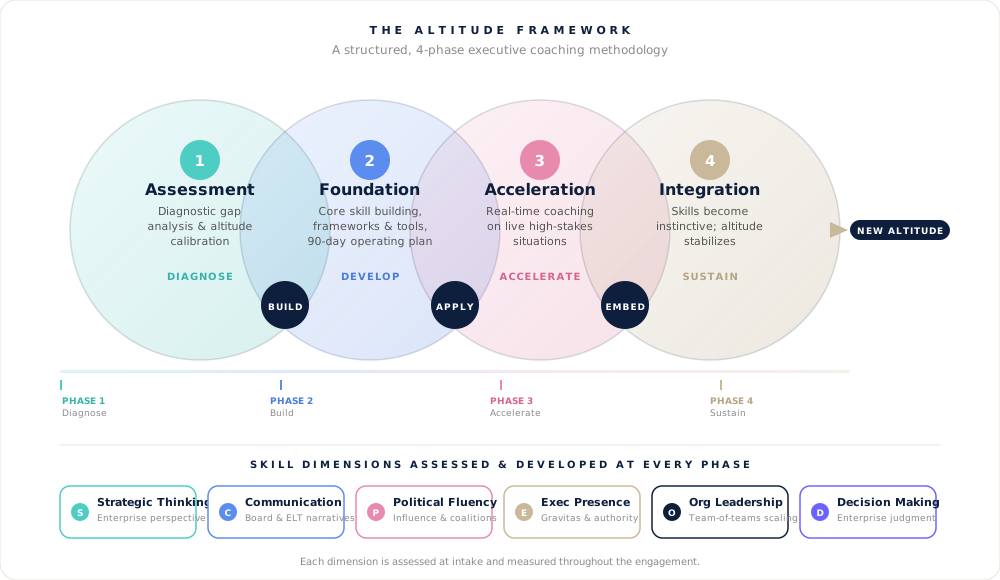
The Altitude Framework is Stratos Coaching's four-phase methodology: the Altitude Assessment, Foundation Building, Acceleration, and Integration. Engagements run 6–12 months, with 60-minute sessions every two weeks and asynchronous access between sessions, and every phase produces a written deliverable, from a gap assessment to a forward-looking development plan.

Why It Matters

Why does a skill-based coaching methodology matter?

We built the Altitude Framework to treat leadership as a set of learnable, measurable skills. Each session is structured around skill development, each engagement produces written deliverables, and outcomes are tracked against what your role requires.

The coaching draws on direct operating experience at VP, SVP and C-suite level, grounded in the situations you need to navigate. For a fuller picture of what high-quality work in this field looks like, read our breakdown of what great executive coaching looks like.

Structured executive coaching methodology
The Complete Framework

How does The Altitude Framework work?

The Altitude Framework: 4-phase executive coaching methodology — Assessment, Foundation, Acceleration, Integration
Phase 1

What happens in the Altitude Assessment?

Diagnostic gap analysis: where you are versus where you need to operate.

The Altitude Assessment is a structured evaluation of where you currently operate across five dimensions of executive leadership: strategic thinking, executive communication, decisiveness under ambiguity, people leadership, and cross-functional influence. If you are curious about what happens in an executive coaching session, this is where it starts.

We compare how you operate now against what your specific role demands. A new VP at a Series C company faces different requirements than a CTO at a Fortune 500. The assessment is calibrated to your context rather than to a generic leadership model.

What you receive: A written gap assessment documenting where you currently operate on each dimension, the specific gaps between where you are and where you need to operate, and prioritized recommendations for your coaching engagement.

Phase 2

How does Foundation Building work?

Building the core executive skills your role demands.

Based on the Altitude Assessment, we identify the two or three foundational skills that will have the highest impact on your performance. These become the focus of intense, structured coaching over the first four to eight sessions.

Foundation Building uses your real business challenges as the coaching material.

If the gap is strategic communication, we rebuild your next ELT presentation together. If the gap is reading the organization, we map your actual stakeholders and plan how to win their support. Every session produces something you can use the same week.

What you receive: An operating plan tailored to your specific role and gaps, frameworks and tools for the foundational skills we develop together, and structured practice on live business challenges.

Leaders working through a structured coaching process
Phase 3

What happens during Acceleration?

Real-time coaching on live challenges as skills sharpen.

Once the foundational skills are in place, coaching shifts to real-time application. You bring your most challenging situations into the sessions and we work through them together: a board presentation that needs to land, a difficult conversation with a peer, a strategic decision with incomplete information.

In Acceleration the coaching connects directly to business results. You apply the skills under pressure and get feedback in real time, which speeds your development beyond what experience alone provides. See our analysis of executive coaching ROI for how this phase produces measurable business impact, and the broader executive coaching statistics behind it.

What you receive: Real-time coaching on your highest-stakes situations, progressive skill refinement based on live application, and between-session support for time-sensitive challenges.

Phase 4

What does Integration look like?

Skills become instinctive and the new way of operating holds.

The goal of every engagement is integration: the point where the skills we developed become your default operating mode. Strategic framing and stakeholder management no longer take conscious effort.

For clients on our Annual Partnership, this phase includes ongoing coaching sessions at a reduced cadence, focused on keeping the gains and addressing new challenges as they emerge. For coaching clients completing an Accelerated Engagement, we provide a transition plan so the skills keep developing after the engagement concludes.

What you receive: A forward-looking development plan for continued growth and optional ongoing advisory support at a reduced cadence.

What does coaching look like in practice?

Consider a newly promoted VP who still reviews every decision their directors make. Work keeps returning to the VP, the directors hesitate to act independently, and strategic priorities receive too little attention.

This is a hypothetical illustration of the coaching process, not a client case or promised result.

1. Define the change that matters

Instead of a broad goal such as “delegate more,” the leader identifies a practical target: give directors clear ownership of agreed decisions, with defined limits and escalation points.

2. Understand what gets in the way

The included DISC assessment and 360-degree review inform the discussion. DISC offers a starting point for exploring behavioral preferences; the 360 adds stakeholder perspectives. Neither substitutes for examining actual decisions and working relationships. In this example, an intention to be helpful might be experienced as taking work back.

3. Practice a different behavior

The leader and coach work through an upcoming delegation conversation. The VP clarifies the outcome, decision authority, constraints and check-in points, then asks the director to explain how they will proceed. Between sessions, the VP tries this on a real assignment. The next session examines what happened and what to adjust.

4. Look for observable progress

Possible indicators include fewer unnecessary approval requests, clearer ownership and more decisions made at the agreed level. Stakeholder feedback tests whether others can see the change. These are example measures to adapt, not guaranteed targets or outcomes.

5. Make the change repeatable

The leader applies the approach to additional decisions and documents the habits that help it hold. The aim is a more effective way of leading through other leaders.

What happens before coaching begins?

Start with a free 30-minute Altitude Call by phone to discuss your situation and whether coaching fits. Your proposal follows within two business days and includes a free 90-Day Altitude Game Plan outlining initial priorities and practical next steps. This starting point is refined through the DISC assessment, 360-degree review and deeper conversations once coaching begins.

The Operating System

What does an engagement look like week by week?

The Altitude Framework has four phases. Here is what they look like on a calendar. Engagements run 6–12 months with two 60-minute sessions a month; a 12-month engagement extends Acceleration and Integration rather than adding phases.

WhenWhat happensWhat you get
Before day oneComplimentary 30-minute Altitude Call by phone. We map your current role, the transition in front of you, and the specific situations you are navigating. If coaching is not the right move, you hear that here.A written engagement proposal within two business days, including a free 90-Day Altitude Game Plan
Week 1Altitude Assessment begins. Structured evaluation across the five dimensions of executive leadership. DISC behavioral assessment and included 360-degree review begin. The stakeholder feedback format and confidentiality boundaries are agreed for the engagement.Assessment underway
Week 2First working session. Assessment results are worked through together, not handed over. Three to five specific goals set, each with an observable behavioral marker attached.Written gap assessment. Development plan with measurable goals
Weeks 3–8Foundation Building. Sessions every two weeks, 60 minutes, with asynchronous access between sessions. Work concentrates on the two or three capabilities the assessment identified as most important, rather than everything at once.Stakeholder maps, operating-model drafts, communication frameworks
Month 2First checkpoint. Are the behavioral markers moving? What is landing, what is not, and what needs to change in the plan.Checkpoint note against each goal
Months 3–4Acceleration. The work moves to live, high-stakes situations as they arrive: board presentations, ELT dynamics, reorganizations, succession conversations, difficult peers. Rehearsal before, debrief after.Session-by-session preparation and debrief
MidpointFormal midpoint review. Every goal assessed against its behavioral marker. Scope adjusted where the role has moved underneath you.Midpoint review of each goal
Months 5–6Integration. Consolidating the new operating model so it holds without a coach. The focus shifts from doing the work together to you running it and reporting back.Handover of the operating model
Wrap-upClosing Altitude Assessment: the same five dimensions, scored again and compared against week one.Closing gap assessment and forward development plan
The Diagnostic

What five dimensions do we coach and measure?

The Altitude Assessment evaluates a leader across five dimensions. Every Stratos Coaching engagement opens and closes with the same five-dimension assessment, and the comparison between the two is the evidence of change.

  1. Strategic thinking. The shift from owning execution to owning direction, setting a multi-year thesis and defending it under pressure.
  2. Executive communication. Landing a clear senior-level message in unscripted meetings: recommendation first, then the reasons, whether you had a week to prepare or were pulled into a review cold.
  3. Decisiveness under ambiguity. Committing on large, open-ended problems instead of waiting for a picture that never gets perfect, and treating a wrong first move as data rather than a verdict.
  4. People leadership. Hiring well, running honest growth conversations, calibrating fairly, and delegating so the team scales beyond what you can personally touch.
  5. Cross-functional influence. Winning alignment and buy-in from peers and teams you do not control, where the work gets done through people who do not report to you.

Working on all five at once spreads the coaching too thin. The assessment identifies the two or three that matter most for this leader in this role, and the engagement concentrates there. For the week-by-week engagement calendar and how outcomes are measured, see our track record. For how these dimensions map to the five most common failure modes at SVP level, see why VP-to-SVP transitions fail.

Executives applying the coaching methodology in a team session
Measuring Progress

How do we measure coaching outcomes?

Written Gap Assessment
Every engagement begins and ends with a written assessment of how you operate across the five dimensions. The comparison between your initial and final assessments provides concrete evidence of skill development.
Behavioral Markers
We define specific, observable behavioral markers for each skill we develop. Each is a concrete change in how you communicate, decide, or lead that others can observe.
Business Outcomes
The ultimate measure of coaching is business impact. We track outcomes like successful transitions, board feedback, stakeholder relationships, team performance, and career progression against the goals set during the assessment.

How we count an outcome

What counts as a transition. A promotion, an expanded scope, or a confirmed successor designation that occurs during an engagement or within twelve months of its close.

What assessments are included. A DISC behavioral assessment, a 360-degree review and a Strategic Development Plan are included in every engagement.

What is self-reported. Promotion outcomes, engagement scores, and attrition figures are reported by the client or their organization. Stratos Coaching does not independently audit employer data.

Key Takeaways

  • Every engagement opens with a DISC behavioral assessment and a 360-degree review, both at no additional cost.
  • The Altitude Framework runs four phases (assessment, foundation building, acceleration, integration) across a 6- to 12-month engagement.
  • Sessions are 60 minutes every two weeks, with asynchronous access between them, tracked against three to five written development goals.
  • The methodology draws on direct VP, SVP and C-suite operating experience. Explore the coaching experience and how to start an engagement.
Professionals planning together in a collaborative workspace
Frequently Asked Questions

What do leaders ask about our methodology?

What is the Altitude Framework?

The Altitude Framework is Stratos Coaching's four-phase coaching methodology: Altitude Assessment, Foundation Building, Acceleration, and Integration. It is built for leaders in a major role transition: the career moments when the skills that earned the promotion are no longer enough for the role ahead. Each phase produces a concrete output, from a DISC-informed development plan to a measurable wrap-up review.

How does a Stratos Coaching engagement work?

Every engagement starts with a complimentary 30-minute altitude call. From there, your coach uses the included DISC behavioral assessment and 360-degree review, builds a development plan with three to five measurable goals, and works the plan with you in structured 1:1 sessions. Progress is reviewed at midpoint and wrap-up so the change sticks.

What assessments are included?

A DISC behavioral assessment and a 360-degree review are included in every engagement at no additional cost. Together they ground the development plan in how you actually operate under pressure (how you communicate, decide, and respond to conflict) rather than on generic leadership theory.

How is progress measured?

Against the development plan. Each engagement sets three to five specific goals up front, reviews them at midpoint, and measures outcomes at wrap-up: promotion readiness, board-ready communication, stakeholder feedback. For market context on what coaching costs and returns, see our executive coaching cost guide. For how to compare providers at this level, see our guide to executive coaching firms.

Ready to see the Altitude Framework in action?

Start with a complimentary 30-minute altitude call. We will diagnose your specific gaps and show you how the framework applies to your situation.

Book a Free Call
Book a Free Call